AKEYO AFRICA

The Akeyo Model
In building Akeyo, we are on a mission to change how agricultural development and agricultural extension is done. Our approach is grounded in strong scientific evidence, but tailored through constant, real-world testing. We listen, learn, and iterate until we get it right for the farmers we serve.
Our model is based on partnerships and business model innovation. That's why we use existing, proven methods where possible. Input suppliers and savings groups already in place are key to our model. We wish to change the unit economics of delivery and extension, thus adding scalable efficiency to proven elements systems.
Rather than replacing what is already there, we amplify existing structure through (mostly offline and simple) technology and strategic partnerships. Instead of creating new financial institutions, we strengthen existing savings groups with relevant products and training.
Accountability by Sales
Our commitment to meet farmers' needs is at the heart of our financial model. We do not provide products and services for free, but offer farmers the opportunity to buy services and goods at affordable prices.
We do this to create a sustainable operation. But just as importantly, we do it to ensure relevance. From our experience, farmers can and will pay a small fee to watch a training video or buy our organic seeds, but only if they see a clear value in what we provide. We document our impact in reports, but our relevance is also ensured because farmers choose us as customers. We call it "Accountability by Sales".
This principle creates a powerful loop. It ensures that every training and every product we offer is genuinely needed, it provides our agents with a dignified income, and thus contributes to making the savings groups sustainable and scalable.
The Trio: Finance, training, inputs
We believe in a farmer-centric approach. We are on a journey to change the unit economics of extension, servicing agents better and more sustainably than at present. The starting point is the three elements below. All of them have been tested and proven separately, and Akeyo employs them jointly to create a scalable, cost-efficient model.

Savings groups
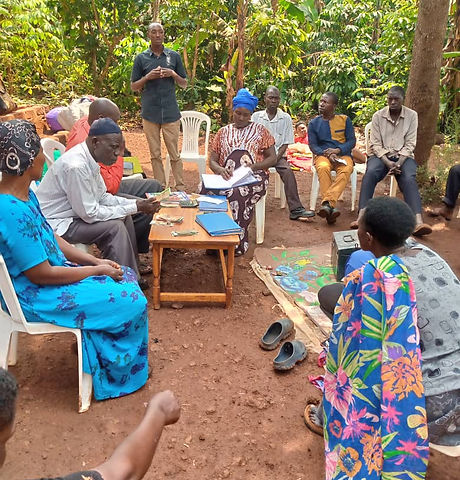
Savings groups are groups of 15-30 people who save in a metal box and provide loans and insurance.
Akeyo will use savings groups as a platform for marketing and training.
Currently 70,000 groups are registered in Uganda only, set up and used mostly by local and international NGOs.

Video trainings
Videos provide a standardized and cost-effective approach to training in farming techniques and climate-smart practices.
In Akeyo, videos are also a marketing tool used to sell equipment.
Evidence shows that videos are effective in promoting new approaches and techniques. Thousands of tried and tested videos in local languages already exist.

Equipment
Akeyo will offer equipment for farmers which is not available locally.
This includes hermetic bags for storage and post harvest handling, quality tarpaulins, and vegetable seeds.
A wide range of products that fit the needs of small-holder farmers exists, but delivery remains a challenge.
Due to our focus on sustainability, Akeyo is committed to principles of agro-ecology and does not promote synthetic fertiliser or chemical pesticides.